Enhancing Accessibility Through Community-Led Alignment Workshops
I co-designed an accessible workshop framework that helps organizations identify inclusion gaps, align on priorities, and translate lived-experience insights into actionable change. By structuring the workshop flow, exercises, and service blueprint, I enabled teams to move from assumptions about accessibility to evidence-based, user-centered decision making.
Eventida developed a series of Alignment Workshops to help organizations understand their current inclusion landscape, uncover accessibility barriers, and collaboratively design next steps. I helped shape the structure, research foundation, and service flow for this evolving productized service.
Role : UX Designer & Researcher
Timeline : 6 months
Tools: Figma, Miro, Google Doc, Google Analytics
Scope: Product Stratergy, Co-design workshops, UX Research Studies, Facilitation workshops
Result & Impact
100%
of 3 client organizations left the workshop with a defined accessibility priority roadmap and assigned owners.
2X
reuse rate of a single service blueprint without redesigning the core structure.
90%
increase in understanding of accessibility roles higher post-workshop across all 3 client engagements.
100%
of the 3 leadership teams moved from fragmented ownership to shared accessibility accountability.
Context & Problem
💼 Business challenge
- Organizations lacked a structured way to understand their accessibility and inclusion gaps.
- Existing accessibility efforts were fragmented and not strategically aligned.
- There was no clear, repeatable framework to guide decision-making.
👤 User + accessibility challenge
- Teams lacked reliable, intersectional, lived-experience data to guide accessibility decisions.
- They struggled to convert insights into actionable UX and product strategy.
- They had difficulty engaging disabled users and co-design partners meaningfully.
Goals & Success Metrics
Goal 1
Reduce misaligned accessibility efforts through structured, evidence-based alignment.
Goal 3
Increase clarity and representation of real challenges across diverse team members.
Goal 2
Create a scalable, repeatable workshop framework organizations can adopt.
Goal 4
Enable cross-functional alignment and shared ownership of accessibility decisions.
Research & Insights
We surveyed 500+ participants to understand common inclusion gaps across industries.
Patterns showed:
- inconsistent accessibility practices
- lack of role clarity
- discomfort discussing disability needs
- misalignment between intention vs impact
We conducted semi-structured interviews with org leaders, employees, and accessibility practitioners.
Key insights:
- teams feel accessibility is important but “don’t know where to start”
- workshops need to create psychological safety
- tools must accommodate varying levels of accessibility maturity
We observed 3 in-person or hybrid workshops/meetings to see:
- how teams collaborate
- accessibility breakdowns in real-time
- friction points in communication & exercises
We grounded our decisions in research around:
- inclusive facilitation (Microsoft Inclusive Design, Stanford D-School equity work)
- accessibility communication patterns
- psychological safety
- participatory design
- cognitive load principles
Insights
The disabled community faces systemic barriers that make it difficult to access opportunities. The hiring and employment processes are often not designed with equity and inclusion in mind, leaving disabled talent overlooked.
To be a truly inclusive leader, one must ensure that those most affected by inaccessibility and exclusion are given a seat at the decision-making table. These community members should be among the driving forces behind innovation.
The current data landscape often lacks intersectionality, leading to the invisibility of minorities and reinforcing sampling biases. This flawed data skews the design process, resulting in products and services failing to meet diverse populations’ needs.
Problem Framing and Design Principles
Problem Framing
Organizations want to be inclusive, but lack a structured, accessible process to understand their current state, identify gaps, and align on priorities. Without clear workflows, inclusive exercises, or a guiding framework, workshops fall into unproductive discussion or vague direction.
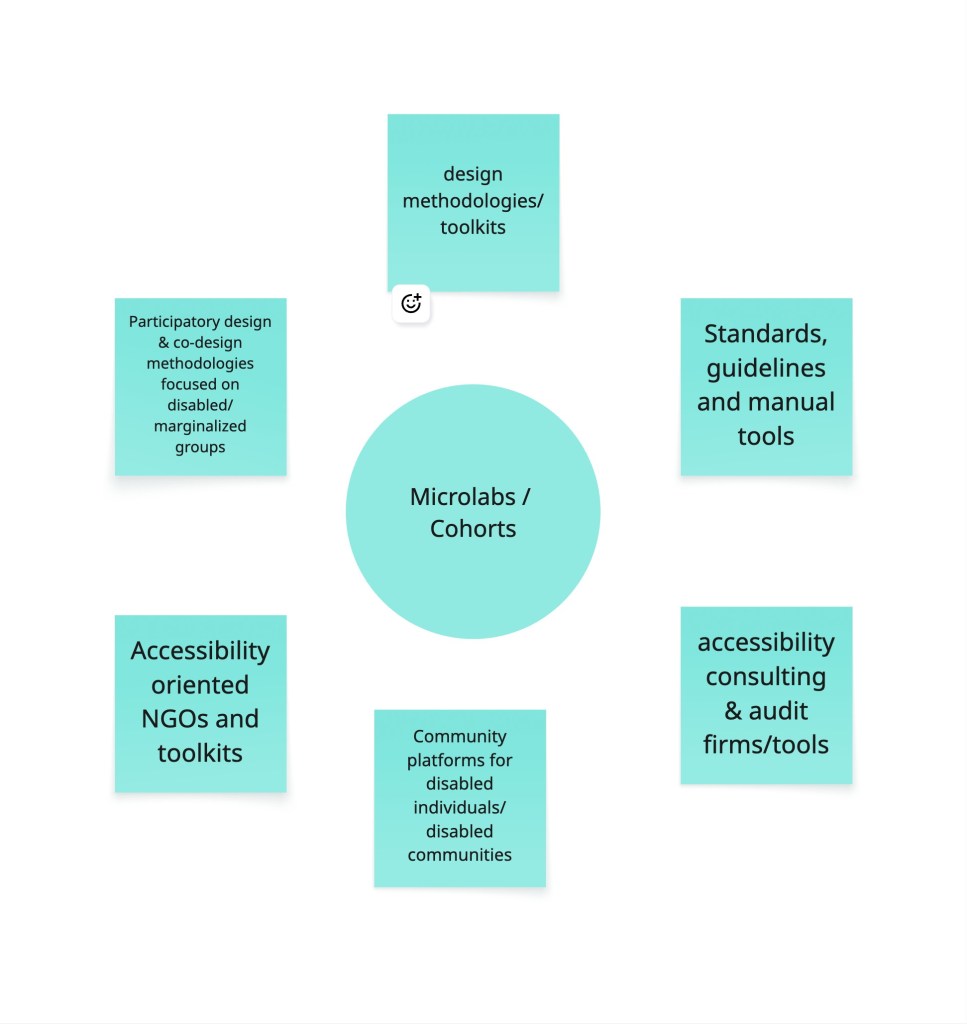
We needed a scalable system that captures real lived experiences, reduces cognitive load for teams, and transforms community-driven insights into practical accessibility actions.
Our challenge was to design an experience that:
Reduces cognitive load
Supports diverse participants
Creates psychological safety
Provides structure & clarity
produces actionable, organization-ready outcomes

Design Outcomes
Cohort Springboard for facilitation workshops and community-driven research studies.
End-to-End Workshop Flow Blueprint
I designed the service flow for the workshop:

This helped reduce ambiguity and provided predictable structure.
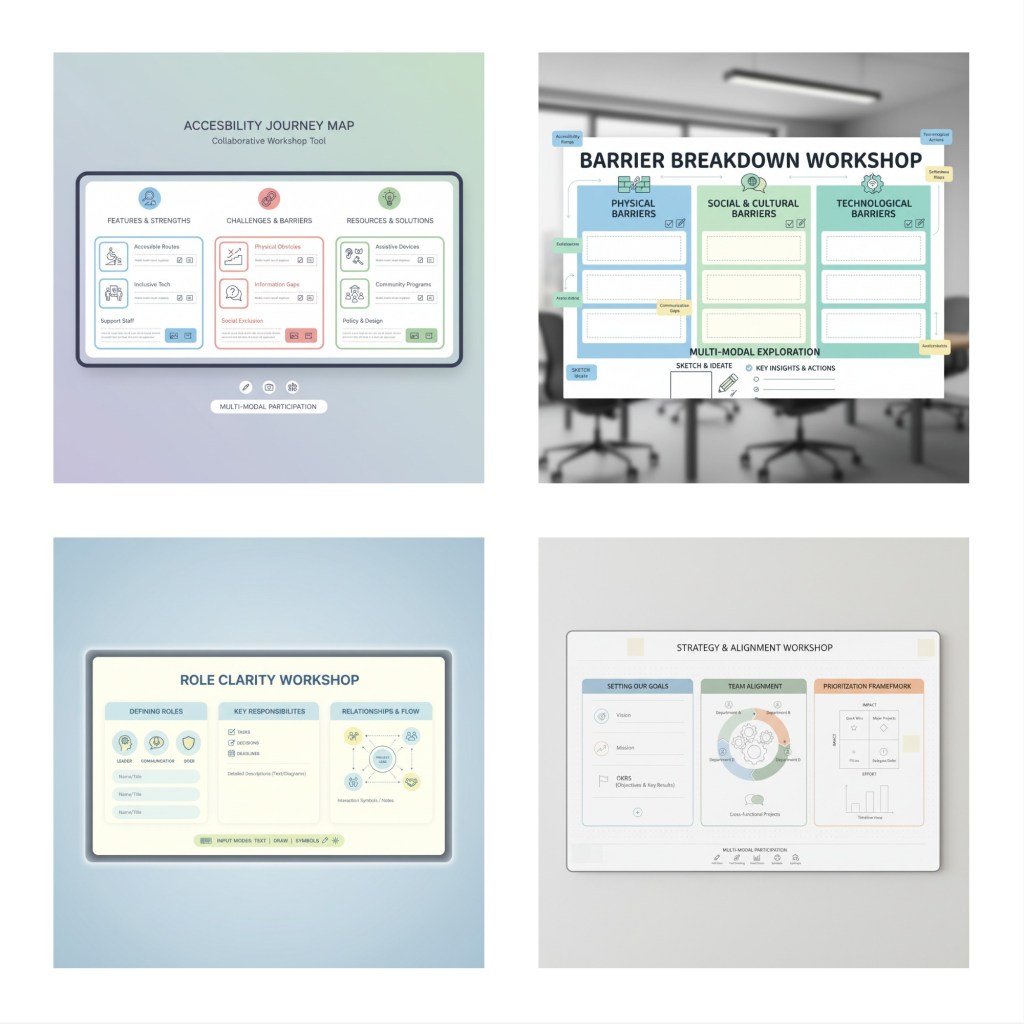
Accessible Exercise Templates
I created or refined templates for:
- accessibility mapping
- barriers identification
- role clarity
- goals alignment
- prioritization frameworks
Each template was built for clarity, multi-modal participation, and minimal cognitive load.
Research-Informed Framework Architecture
I developed the conceptual structure behind the workshop:
- stages of inclusion maturity
- categories of accessibility barriers
- roles & ownership models
- alignment indicators
This gave the product a strategic backbone.
Service Blueprint for Facilitators
To support Eventida’s ability to scale, I designed a facilitator-facing workflow including:
- timing
- touchpoints
- accessibility requirements
- expected outputs
This reduces inconsistencies across facilitators and increases repeatability.
Future-Facing Recommendations
As the project continues, it still needs to be worked on:
- deepening support for lived-experience experts
- refining exercises based on pilot feedback
- improving documentation for hybrid formats
Leadership + Collaboration
- Led accessibility workshops
- Built roadmap priorities
- Unified cross-functional decisions
- Established repeatable workflow standards
Reflection & Next Steps
What I learnt
- Service design requires balancing clarity with flexibility.
- Accessibility must start with cognitive and emotional safety.
- Structure is essential for inclusive participation.
Next Steps
- Add more lived-experience exercises
- Develop facilitator training modules
- Enhance accessibility in digital templates
Farheen Samad is value driven designer who wanted to become an environmentalist, an engineer, a cat and most recently want to become someone who makes sustainable, equitable and human experiences. I would recommend her for your team.
Contact Me
© 2025, All rights reserved.
Designed with 🫖 and 💙
 farheensamad